
Agentic systems · Generative AI
Digital marketing adviser
A multi-agent LLM workflow designed to transform marketing briefs into structured analysis, campaign strategy, and creative concepts through specialized reasoning stages.
- Context
- Ipsos
- System
- 3-agent workflow
- Contribution
- Agent orchestration
From a short marketing brief to a structured chain of interpretation, strategic formulation, and creative translation.
The challenge
From an open brief to a structured campaign
A marketing brief can be remarkably compact. A brand, a target, a product, and a campaign objective may fit into a few sentences. Turning that brief into an actionable campaign, however, requires several distinct forms of reasoning.
The market first needs to be interpreted; observations then need to become positioning and strategy; only then can strategy become creative concepts, formats, messages, and calls to action.
The challenge was therefore not simply to generate marketing content with an LLM.
It was to structure the reasoning between the brief and the final creative direction.
The prototype approached this as a sequence of specialized responsibilities, each transforming the output of the previous stage before passing it downstream.
Decomposing the task
One request, three reasoning stages
Instead of asking a single model to move directly from a campaign request to creative concepts, we decomposed the task according to the type of decision being made.
Understand
The first stage interprets the marketing environment surrounding the request.
It considers the audience, market tendencies, and competitive context to construct an initial reading of the problem.
Formulate
The second stage converts this interpretation into a campaign strategy.
Segmentation, targeting, positioning, the marketing mix, and a core message provide a bridge between market understanding and execution.
Translate
The final stage turns strategic direction into creative propositions.
Campaign formats, titles, visual and emotional tones, hashtags, and calls to action translate an abstract strategy into concepts that could be communicated.
Understand
Interpret the market
- Market context
- Audience
- Competition
Formulate
Define the strategy
- Segmentation
- Targeting
- Positioning
- Marketing mix
- Core message
Translate
Shape the creative direction
- Creative concepts
- Formats
- Visual direction
- Emotional tone
- Call to action
This decomposition became the organizing principle of the system.
From brief to creative direction
Specializing the reasoning
Each reasoning stage was implemented as a specialized LLM role.
The Analyst receives the brand and original campaign request and produces a market-oriented interpretation. The Strategist uses that analysis to formulate a marketing strategy. The Designer then translates the strategy into creative concepts.
Brief
- product
- audience
- constraints
- objective
Market interpretation
- trends
- audience
- frictions
- drivers
- competition
Campaign strategy
- STP
- 4P
- positioning
- message
Creative concepts
- concept
- format
- claim
- visual direction
- tone
- CTA
Inside the workflow
Passing context between agents
LangGraph maintained a shared MarketingState containing the original inputs and the successive outputs produced by the workflow.
LangGraph encoded the sequence as a controlled stateful workflow: agents as specialized transformations rather than independent conversational personalities. The architecture did not attempt autonomous planning, negotiation, or dynamic task allocation — only whether separating the problem into explicit stages could structure the path from brief to campaign concept.
At the system level, this gives the pipeline a common state. At the prompt level, however, each agent receives only part of that information.
The Analyst starts from the original brand and query.
The Strategist receives the brand and the Analyst's interpretation.
The Designer receives the resulting strategy.
Analyst output · contemporary prototype reproduction · fictional brief
{
  "market_analysis_report": {
    "brand": "Northstar Coffee",
    "project": "Lancement de la gamme de café éco-responsable (Low-Waste)",
    "target": "Jeunes professionnels urbains (25-39 ans)",
    "1_tendances_du_marche": {
      "premiumisation_et_cafe_de_specialite": {
        "description": "Croissance soutenue de la consommation de café de spécialité à domicile post-pandémie.",
        "impact": "Les consommateurs refusent de transiger sur le goût et recherchent une expérience de barista sans effort technique."
      },
      "durabilite_radicale_et_zero_dechet": {
        "description": "Rejet croissant des emballages à usage unique (notamment les capsules en aluminium/plastique non recyclées).",
        "impact": "Forte traction pour les emballages compostables à domicile, les systèmes de recharge et les modèles d'économie circulaire (consigne)."
      },
      "praticite_sans_culpabilite (Guilt-Free Convenience)": {
        "description": "Besoin de solutions rapides le matin adaptées aux modes de vie actifs et hybrides (télétravail/bureau).",
        "impact": "Succès des formats à infusion rapide (drip bags, concentrés, capsules biosourcées) combinant gain de temps et impact environnemental neutre."
      }
Complete Analyst output
{
  "market_analysis_report": {
    "brand": "Northstar Coffee",
    "project": "Lancement de la gamme de café éco-responsable (Low-Waste)",
    "target": "Jeunes professionnels urbains (25-39 ans)",
    "1_tendances_du_marche": {
      "premiumisation_et_cafe_de_specialite": {
        "description": "Croissance soutenue de la consommation de café de spécialité à domicile post-pandémie.",
        "impact": "Les consommateurs refusent de transiger sur le goût et recherchent une expérience de barista sans effort technique."
      },
      "durabilite_radicale_et_zero_dechet": {
        "description": "Rejet croissant des emballages à usage unique (notamment les capsules en aluminium/plastique non recyclées).",
        "impact": "Forte traction pour les emballages compostables à domicile, les systèmes de recharge et les modèles d'économie circulaire (consigne)."
      },
      "praticite_sans_culpabilite (Guilt-Free Convenience)": {
        "description": "Besoin de solutions rapides le matin adaptées aux modes de vie actifs et hybrides (télétravail/bureau).",
        "impact": "Succès des formats à infusion rapide (drip bags, concentrés, capsules biosourcées) combinant gain de temps et impact environnemental neutre."
      }
    },
    "2_insights_audience_cible": {
      "profil_demographique_et_psychographique": {
        "segment": "Jeunes actifs urbains (Gen Z tardive / Millennials, 25-39 ans)",
        "mode_de_vie": "Rythme de vie intense, digital-natives, sensibles au design, soucieux de leur impact carbone et de leur statut social éco-responsable."
      },
      "points_de_friction_pain_points": [
        "Dissonance cognitive : désir d'un café rapide le matin vs culpabilité liée aux déchets d'emballage.",
        "Méfiance envers le greenwashing des marques traditionnelles.",
        "Déception passée face aux alternatives écologiques perçues comme gustativement inférieures."
      ],
      "facteurs_declencheurs_d_achat_drivers": [
        "Preuve tangible de qualité (notes SCA, origine éthique, torréfaction artisanale).",
        "Simplicité d'usage intégrée à la routine matinale (gain de temps).",
        "Esthétique soignée du produit et transparence totale sur le cycle de vie de l'emballage."
      ]
    },
    "3_paysage_concurrentiel": {
      "acteurs_etablis_ex_nespresso_starbucks": {
        "forces": [
          "Notoriété de marque hégémonique",
          "Réseaux de distribution massifs et fidélisation solide",
          "Machine install base importante"
        ],
        "faiblesses": [
          "Perception de greenwashing sur les filières de recyclage",
          "Inertie face à la transition zéro déchet réel",
          "Image corporate déconnectée des valeurs des jeunes urbains"
        ]
      },
      "challengers_d2c_et_specialite_ex_grind_cometeer_torrefacteurs_locaux": {
        "forces": [
          "Forte crédibilité sur la durabilité et le goût",
          "Branding lifestyle attractif et engagement communautaire"
        ],
        "faiblesses": [
          "Prix souvent prohibitifs",
          "Disponibilité physique limitée (souvent 100% e-commerce/abonnements)",
          "Complexité d'usage pour certains formats"
        ]
      },
      "opportunites_de_differenciation_pour_northstar": {
        "positionnement_cle": "La promesse 'Zéro Compromis' : l'excellence aromatique d'un micro-torréfacteur, la rapidité d'une solution nomade/urbaine, et un emballage 100% circulaire.",
        "leviers_tactiques": [
          "Miser sur un packaging innovant (ex: capsules 100% 'home-compost' certifiées ou recharges réutilisables élégantes).",
          "Campagne de notoriété axée sur la transparence radicale (traçabilité blockchain / QR code bilan carbone).",
          "Stratégie omnicanale : partenariats avec des espaces de coworking, cafés branchés et livraison express urbaine."
        ]
      }
    }
  }
}This creates an important architectural property: downstream agents do not simply accumulate everything that came before them.
They operate on intermediate representations.
Why specialized agents?
Separation creates structure — and new trade-offs
Breaking the task into specialized stages made the reasoning process easier to inspect.
Instead of receiving one large answer containing analysis, strategy, and creative recommendations simultaneously, each responsibility had an explicit place in the workflow and produced an intermediate output that could be observed independently.
This separation also made the architecture modular: analytical, strategic, and creative stages could evolve independently.
But specialization introduces its own constraint.
Every additional reasoning stage is also another opportunity to transform or lose information.
A downstream agent can only reason from the context it receives. The design of communication between agents becomes as important as the agents themselves.
From workflow to interaction
Making the reasoning visible
The prototype could be operated through both a command-line interface and a Chainlit application.
The browser interface exposed successive workflow stages rather than hiding the process behind a single generated response.
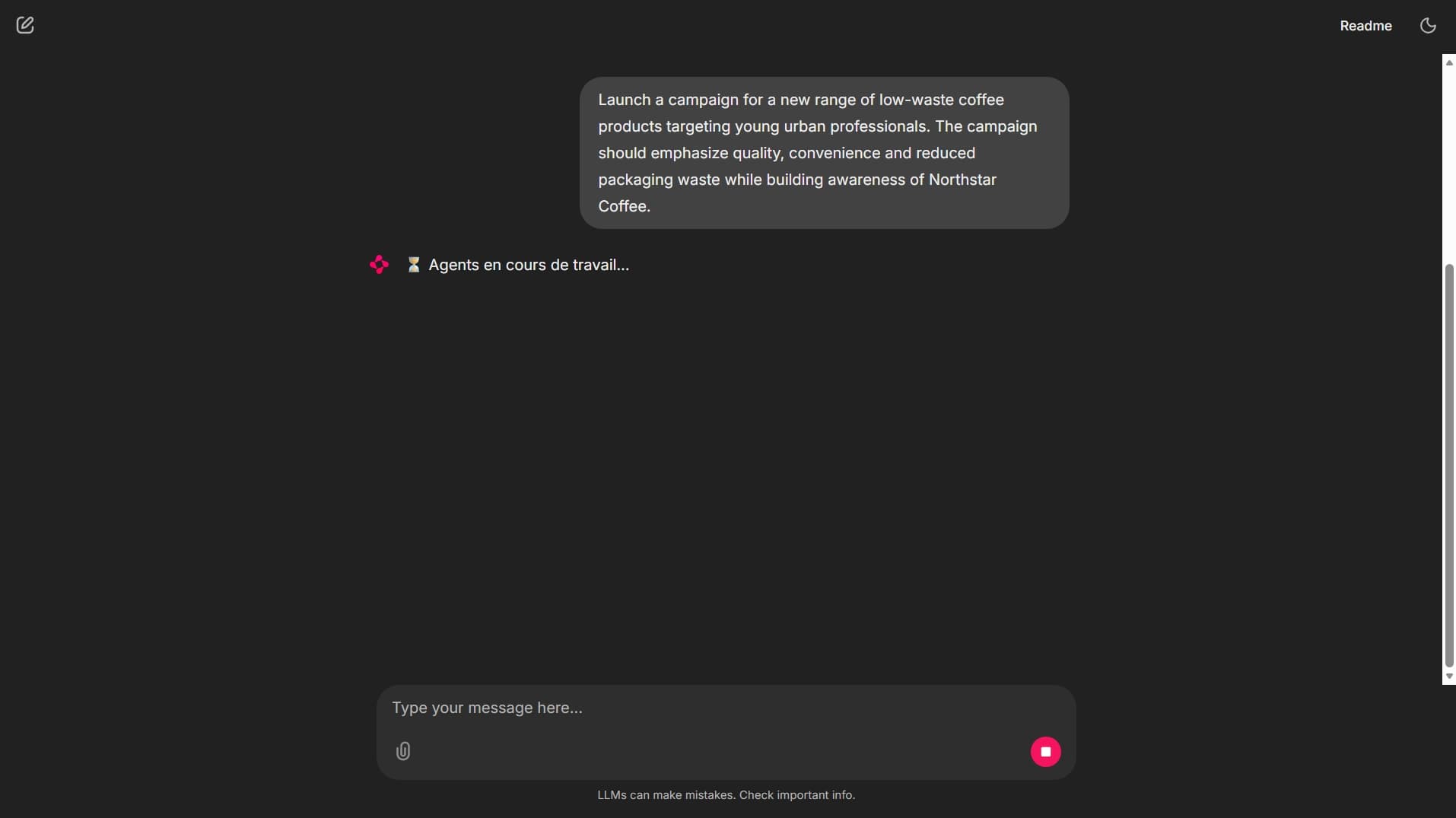
The fictional Northstar Coffee brief submitted to the reproduced workflow and the start of agent execution.
The interaction layer was intentionally lightweight: a usable surface for testing and presenting the orchestration, not a complete marketing platform.
What the prototype demonstrated
A working end-to-end reasoning pipeline
Given a brand and campaign query, the accessible prototype produces market interpretation → campaign strategy → creative concepts in sequence.
The contemporary Northstar rerun documents that end-to-end behavior. It is not preserved evidence from the original 2025 presentation.
What the surviving repository does not provide is equally important. No historical outputs, evaluation dataset, human scoring protocol, or quantitative benchmark were preserved. Claims about campaign quality, marketing effectiveness, or improvement over a single-prompt baseline would be misleading.
The defensible result is architectural rather than performance-based: a specialized LLM workflow implemented and made interactively usable.
What we learned
Specialization is also an information problem
Specialization can improve structural clarity while increasing the risk of information loss between stages. The surviving artifacts did not evaluate that trade-off formally, but the architecture exposes it.
The Strategist does not receive the original campaign query; the Designer reasons only from the resulting strategy. Each stage operates on a progressively transformed representation.

Once introduced upstream, these assumptions can become part of the working context available to subsequent agents.
Which information should an agentic workflow preserve, transform, introduce, and verify as it moves between specialized reasoning stages?
The prototype does not answer that experimentally. The observation comes from the reconstructed implementation and one contemporary reproduction, not from controlled measurement across multi-agent systems in general.
Where we would go next
Several extensions would be needed to make the workflow more robust.
Ground the reasoning
Connect stages to documents, campaign material, structured business data, or external sources rather than the model's internal knowledge alone.
Preserve the right context
Keep selected invariants — original brief, brand constraints, audience, objectives — globally available while intermediate representations evolve.
Structure and evaluate
Typed schemas and validated outputs would make inter-agent contracts explicit. Reference briefs, human assessment, consistency checks, and simpler baselines would be needed to test whether specialization improves results.
Make orchestration adaptive
Conditional routing, critique, revision, or feedback loops could revisit earlier decisions when downstream reasoning exposes gaps or contradictions.
Techniques & technologies
Techniques
- Stateful orchestration
- Role specialization
- Sequential reasoning
- Prompt chaining
Technologies
- Python
- LangChain
- LangGraph
- Gemini
- Chainlit
- Docker
- GitHub Actions






Resources
 Technical report
 Marzsch